

Welcome to our latest blog, where we’re thrilled to share the story of a remarkable English Oak Bonsai Tree (Quercus robur) that has been lovingly styled by bonsai master Lloyd Noall from Bonsai Direct. This oak, believed to be over 60 years old, began as a small garden tree before Lloyd’s expert hands transformed it into a miniature marvel, capturing the grace and strength of a mature oak tree.
Lloyd’s passion for oak trees goes beyond bonsai. In this post, we invite you to join Lloyd on a journey into the wild to see a magnificent ancient English Oak, whose natural structure and beauty serve as an endless source of inspiration. By comparing this full-grown giant to his bonsai creation, Lloyd demonstrates how closely observing nature can guide us in shaping our bonsai trees.
In the video below, you’ll see Lloyd share his approach, from studying the natural twists and rugged bark of mature oaks to crafting those elements into his bonsai designs. Whether you’re a seasoned bonsai enthusiast or just starting out, Lloyd’s insights and techniques will help you see nature as a true teacher in the art of bonsai. Enjoy the journey!
Transcription of Video about this Huge Magnificent English Oak Bonsai Tree – An Inspiration
A quick introduction about the English Oak Bonsai Tree
I love Oak trees, and I really love growing oaks as bonsai. And over the years I have grown hundreds of oaks trees. I have collected the acorns, germinated them and grown them on into some beautiful bonsai. This particular one I didn’t grow from an acorn, it was collected. I was lucky enough to have a friend who had a large garden who wanted some small trees removing from his garden. So I “kindly” helped him out and dug some up and moved them and I have grown them on. This one is looking fantastic. I have been growing it on for 30 years or so and just kept a rough trim. We haven’t done anything really major to it because I wanted it to thicken up and get really chunky. I wanted it to get that powerful Oak look and I think we are nearly there now.
A Beautiful Native Hardy English Oak Bonsai Tree
So what I would like to do it give it a bit of a tidy up. You can see that it is all weedy here. We have got some overgrown branches. It is just about to lose all its leaves and it goes into winter mode. [This was filmed on the 31st October 2024]. Normally, I would wait until all the leaves have dropped off and I can see exactly what is going on. But for the purpose of this video video, it doesn’t look quite nice nice to have some leaves on it. The leaves are reducing down quite nicely, full-size oak leaves are approximately about 4 inches in length.
This is an English Oak, a common Oak known as Quercus robur. It will lose all its leaves soon, but at the moment I think it looks a little bit fuller, so I’m going to demonstrate while it’s in half leaf. Firstly, I’m going to have a tidy up and a good clean and then we will have a look and see what’s going on with all these branches and do a little bit of refinement and over the next 24 months I want to really get stuck in I’m working on the twigs and the ramification, and make sure that all the branches are growing in the right direction as they should. So, the other thing that I’m going to do is go and have a look at some big oaks and get some inspiration.
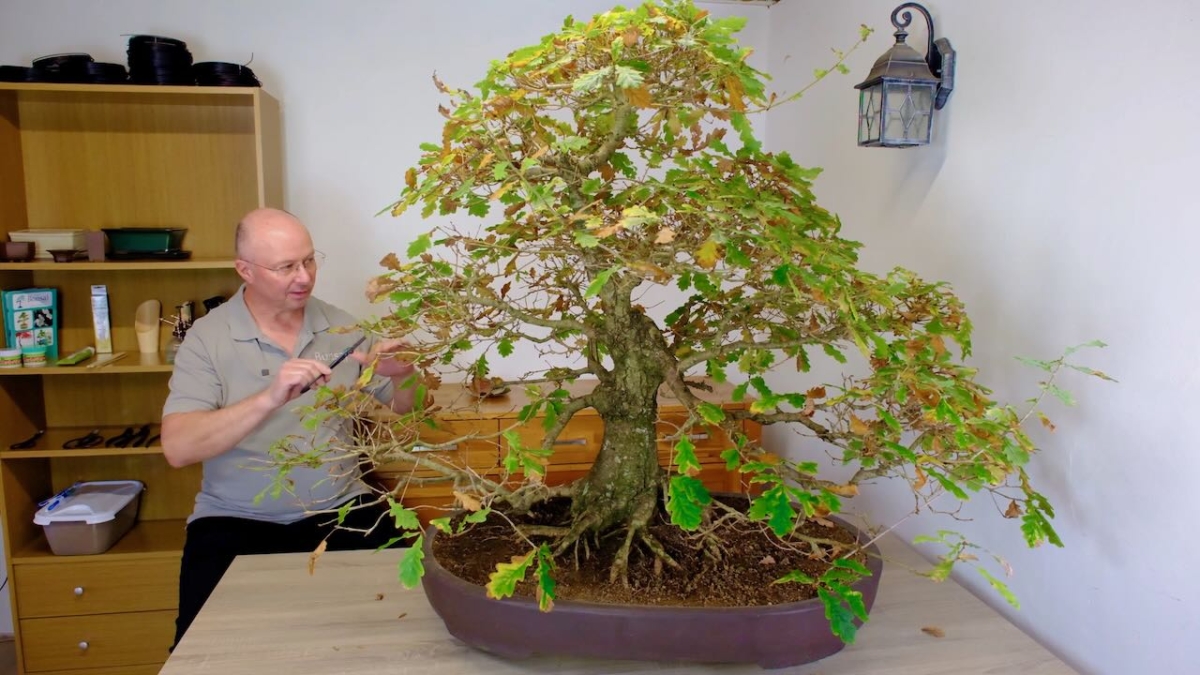
Lloyd Pruning this huge 60 year old Oak Bonsai Tree
Firstly, let’s clean up the soil surface.
Let’s go cleaning, all I’m going to do, with this root rake spatula, is to carefully scrape off the soil surface like this. Be careful not to damage any surface roots. Music playing… Now that looks a lot better. So now we can see the root flare and the base of the tree.
Time for a field trip to see wild English Oak Trees
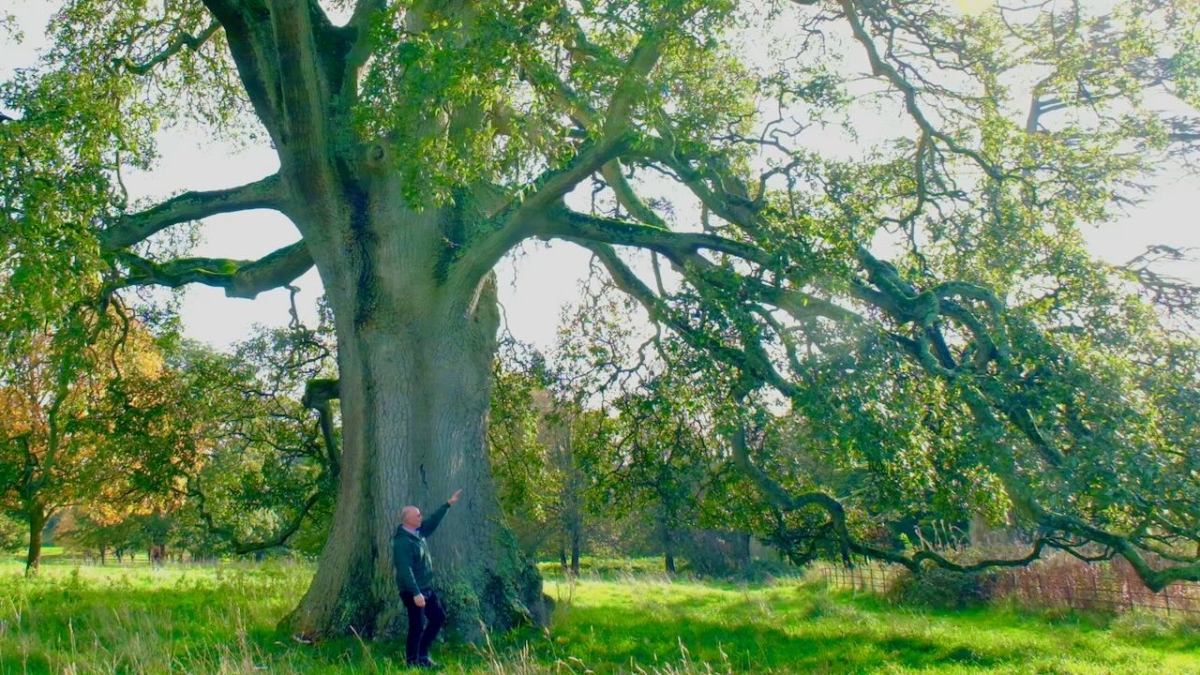
Now is the perfect time to get out of here and go and find a nice big Oak and get some inspiration. So here we are, we have found this fantastic oak tree, it’s not actually an English Oak, it’s an Evergreen Oak, but the shape is very much the same so we can get everything that we need from this particular specimen, so let’s go in and get some close-ups and have a look and see what’s going on and look at the shapes. It’s a great tree that we can learn from.
So, this oak tree has an absolutely amazing trunk. It is a beautiful tree and it has that amazing power. It has a feeling of age, when you look at this it is so strong, stable and has this lovely flare. The bark is beautiful and it’s all gnarly and look at the way the branches just sweep out from the trunk. Beautiful curves. The way this branch just curves down here is exceptional.
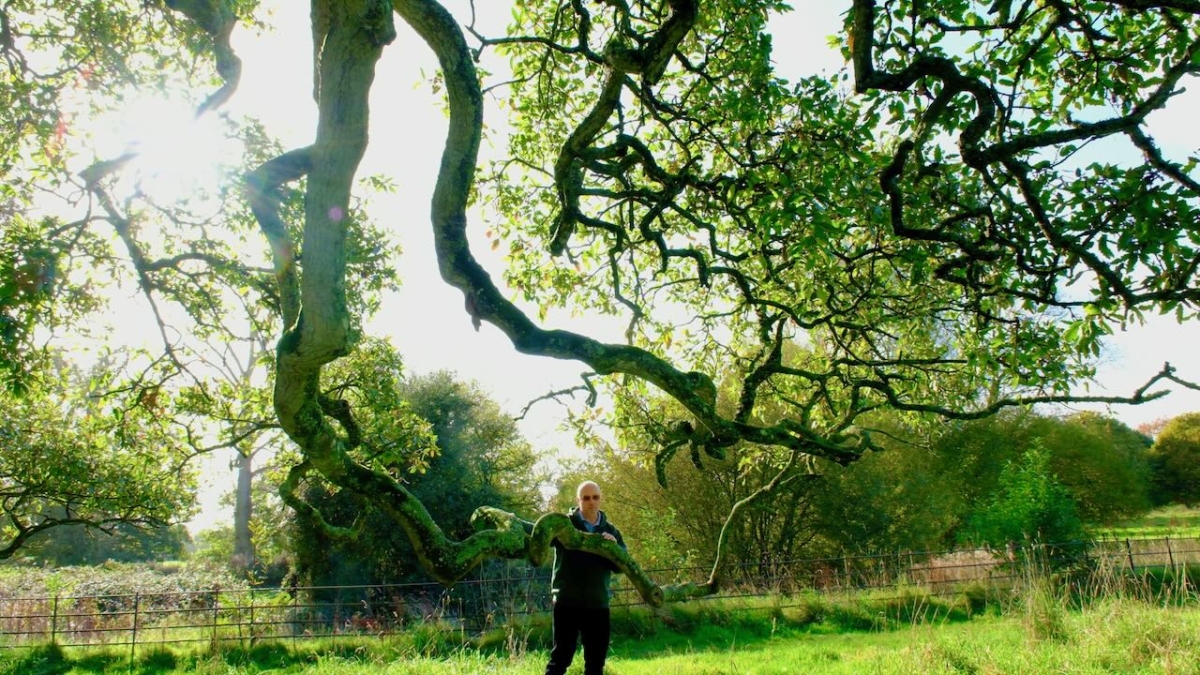
Let’s look at the details.
I really love this branch. It has so much character to it and why did it not just go straight? Here it is it just undulates, and changes and I just love the lovely twists and curved to it. It’s so beautiful and this is the sort of thing I love and want to put into my own Bonsai. It’s beautiful, and that’s what we want, we want to put those sorts of details into our Bonsai. So let’s go back to the workshop and see how we can compare the two now. Let’s see how we can put these curve these details into the Bonsai that we are working on in the workshop.
As you can see, we are off to a good start. Because this Bonsai already has this fantastic trunk. It’s grown on really nicely over the years. It’s chunky and it’s kind of squat. It gives us that power that we need. We already have these main branches, one here and one over here, which have these lovely curves. Do you remember the one in the field? Had this lovely curve and gradually creeps down and undulates out? Our Bonsai hasn’t quite got the curves in it yet on that branch, but those are features that we are going to add over the coming years. So let’s get on and do some shaping…
Initial Pruning of the Twigs
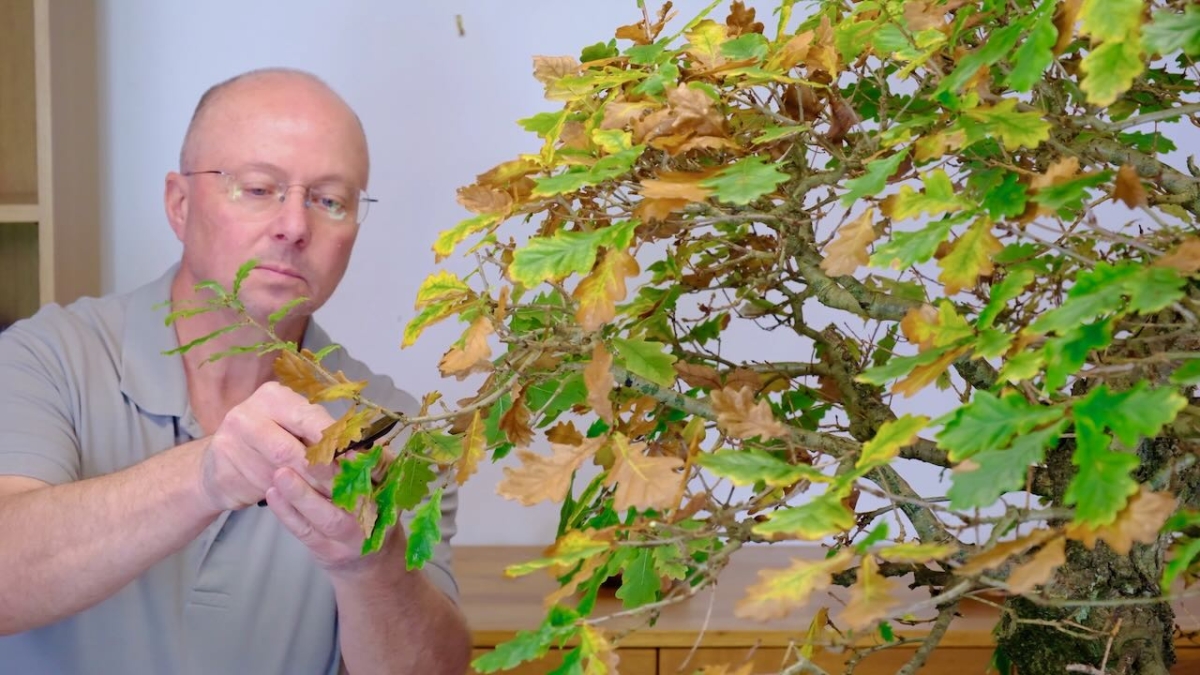
To start off with all I’m going to do is tidy up some of these twigs. I shall prune back some of the ones which are overgrown and ones which I defiantly don’t need to grow on. Then, I shall now go round and give it a quick trim. I shall take these few leaves off to help you see. This heavy shoot coming up, I don’t want that one to grow in that direction, I want to put some strength back down the branch so I’m going to prune this one back. There is a little bud, so I am going to prune back to there, like that.
There is an abundance of buds in this area and by pruning back this heavy shoot, these buds will start to grow next spring. I will then choose from these buds, which ones I would to keep that are growing in the right direction to help shape the branch.
Improving the branch structure & taper.
Now that all the heavy shoots that are sticking in the wrong direction have been pruned and are out of the way I can see deeper into the branch structure and this will allow me to decide which but I’m going to keep and which ones I would prefer to remove. I am continually looking for nice shapes in the twigs, little curves and kinks. I am also looking for a way to improve the taper and the thing with the Oak as it can get quite chunky in places especially as it gets towards the outside of the branches. Bearing this in mind sometimes I have to prune back harder and this will improve the taper as well as the shape. Lloyd is using his concave branch cutters to do this work.
It’s also a great opportunity to clean up any old knobs, so those little stumps leftover from last season pruning I will go over with a pair of Bonsai knob cutters and cut those stumps back so they are “dished” into the main branch. Then that will heal up nicely leaving a tiny scar which you will not be able to see in a year or two. This will improve the flow of the branch and keep it nice and tidy. Now that looks a lot better with all the clutter gone I’m a little twigs and lumps and bumps removed.
Watch Lloyd pruning this magnificent English Oak Bonsai tree
We now have a clean outline of the main branch and twig structure. Some of the twigs we will keep and grow on over the years and some of them we will prune back again. This process is just repeated again and again on each branch. I’ll let you sit back and watch for a bit and hopefully enjoy my pruning.
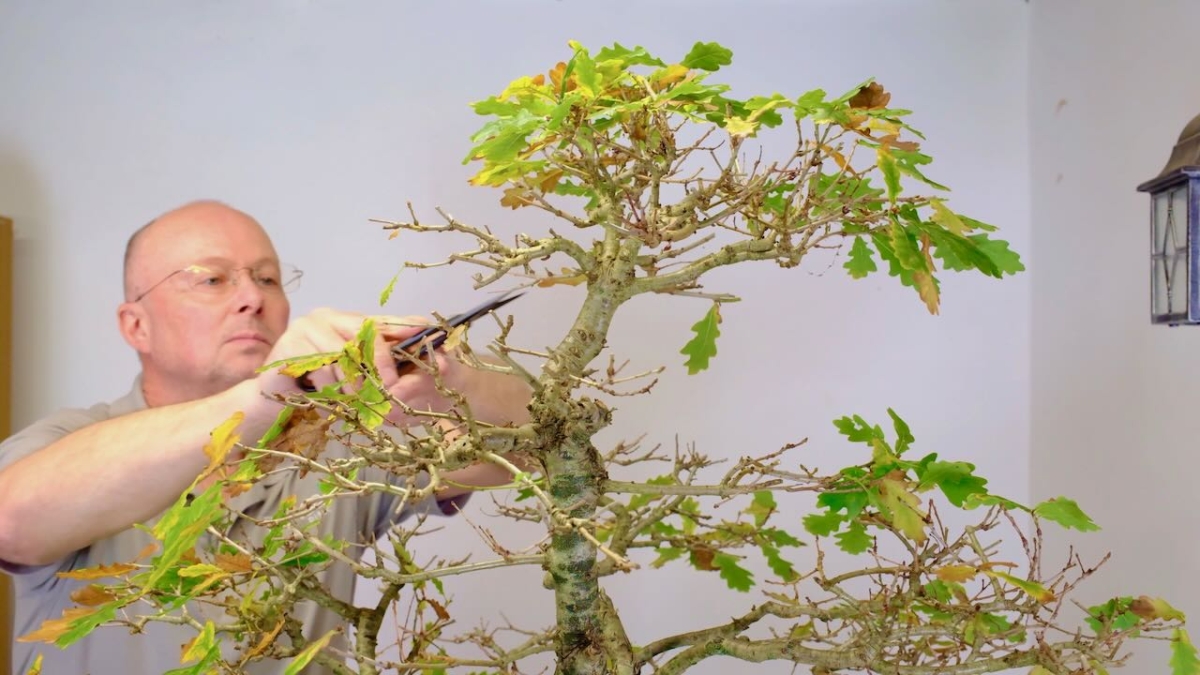
I have a nice pruning sessions. There are still quite a lot of twigs to come off but we can now start to see the really lovely shapes. There are some lovely curves, twists and forks and the taper it’s really nice. It starts off thick and chunky and meanders down and gets smaller towards the edge, which is a really good start. I shall spend the Bonsai around so we can take a look. I love the way the top of the tree comes up forming a nice crown. There is a really nice start to the finer twigs which will start to grow better next year. I shall do some close-ups later on so you can see more clearly, but there are some really great shapes starting to develop here.
And Finally….
There is still a lot more work to do. I need to do some more cleaning up and remove further stumps and bumps, which I will go through and do later. Generally, I’m really happy with the overall shape. The power in the trunk is phenomenal. The taper is extremely good and I’m getting some really nice curves in the branches. There are a few things which still need improving. This lower branch on the left needs to thicken and have more movement which will intern give more character to this lower branch. So I will continue to develop this.
There is also a small amount of work to do further up the trunk and on this floating branch at the back. So if you would like to learn more about all these details and how I shape branches like this and what a floating branch is please hit the subscribe button. This helps me out and you won’t miss the follow-ups about this oak tree. Additionally, if you would like to learn how to take an acorn and get it to this stage (a young semi-trained sapling) and beyond then we will be doing that as well. Please don’t miss out and I hope you have enjoyed it. All the best Lloyd
Oak bonsai trees are renowned for their strength, character, and timeless appeal, embodying the majesty of their full-sized counterparts in miniature form. These trees capture the essence of oak’s enduring nature, making them a popular choice among bonsai enthusiasts.
Characteristics and Appeal of the English Oak Bonsai Tree
Oak bonsai trees are characterized by their sturdy trunks, rugged bark, and distinctive lobed leaves. As they mature, they develop thick, gnarled trunks with beautifully textured bark, giving them an ancient appearance that adds depth to any bonsai collection. The leaves of oak bonsai are particularly striking, featuring rounded lobes that create a unique silhouette. These leaves remain lush green throughout the growing season and often turn warm shades of red and orange in autumn, adding seasonal interest. One of the most charming features of oak bonsai is their ability to produce miniature acorns, mirroring their full-sized counterparts. While it takes time for oaks to reach maturity, the appearance of acorns on a bonsai is a rewarding sight that brings nature’s cycle to life in miniature form.
Symbolism and Strength
The Oak is an emblem of power, strength, ancient wisdom, and survival. Throughout history, various civilisations have revered the oak tree, attributing myths and legends to its existence. As bonsai, oaks represent resilience and a connection to nature’s quiet power.
Popularity and Care
Oak bonsai trees are highly popular due to their hardiness and adaptability. They are resilient and can handle a variety of conditions, making them excellent choices for outdoor bonsai. Oaks adapt well to different weather conditions and are forgiving when it comes to pruning, allowing bonsai artists to style them in ways that enhance their natural beauty.
Care Guidelines:
- Sunlight: Oaks prefer an airy place in sun during the growing season.
- Watering: Please keep the soil damp to the touch.
- Fertilising: Apply bonsai fertiliser weekly throughout the growing season.
- Pruning: Hard pruning is done in early spring before buds open. New shoots are cut back, leaving two leaves to maintain the shape.
- Wiring: Be careful when wiring oaks, as wire marks can be visible for a long time. Guy wires can be a good alternative.
- Repotting: Young oaks should be repotted every two years, older ones every three to five years in late February or early March before the buds start to swell.

0 replies